How to Declutter Your Closet With a Simple Closet Audit
To declutter your closet, do a closet audit: take your clothes out (all at once or one section at a time), hold each piece and sort it into five piles: keep, maybe, donate, sell, and repair or recycle. Ask a few honest questions about anything you hesitate over. Put the maybes in a box with a date on it, then track what you actually wear for 30 days. Whatever you did not reach for in that month goes, and you decide with real numbers instead of guilt.
Here is the audit step by step, plus what to do with everything that leaves.
The short version: (1) clear a space and take everything out, (2) sort into keep, maybe, donate, sell, and repair or recycle, (3) ask the five questions below about anything you hesitate over, (4) box the maybes and write a date on the box, (5) track what you wear for 30 days, (6) let the numbers decide, (7) donate, sell or recycle what leaves, the same week.
Before you start
Block out two to three hours for a full closet, or 30 to 45 minutes per section if you would rather spread it over a week. Have ready:
- Four bags or boxes, labeled Donate, Sell, Repair and Recycle.
- One box for the maybes, plus a marker to write a date on it.
- A mirror, so you can try things on instead of guessing.
- A clear bed or floor, where everything you pull out can go.
Pick a season to audit. In fall, audit your fall and winter clothes and leave the summer box closed; you can judge those pieces properly when it is warm again.
Step 1: Take everything out (or go one section at a time)
Taking everything out works because you see the whole closet at once: the five black T-shirts, the three pairs of jeans that fit the same way. It also forces a decision on every piece, since nothing goes back in without one.
If a whole closet on the bed sounds like too much, go by section instead: tops one day, bottoms the next, then dresses, outerwear, shoes and accessories. The steps are the same. Just finish each section before you start the next, so you never end up with a half-sorted mess at bedtime.
Step 2: Sort every piece into five piles
Pick up each piece and put it in one of these piles. Decide quickly; anything that takes more than a few seconds goes in the maybe pile.
| Pile | What goes in it | Next step |
|---|---|---|
| Keep | You wore it recently and like it | Back in the closet |
| Maybe | You are not sure | Dated box, 30-day check |
| Donate | Wearable, but not for you | Drop off this week |
| Sell | In good shape and worth listing | List it within two weeks |
| Repair or recycle | Fixable, or too worn to wear | Fix it, or recycle it |
Two rules keep the piles honest:
- Keep means you wear it. "I might wear it someday" is a maybe, not a keep.
- Repair means you will actually fix it. Give each repair a deadline, like two weeks. If you have not taken it to the tailor by then, it goes in a different pile.
Step 3: Ask these questions about each piece
For anything you hesitate over, ask:
- Have I worn it in the last year? A full year covers every season and every kind of event. If the answer is no, be honest about why.
- Does it fit me now? Not after a diet, not once it stretches. Now.
- Would I buy it again today? If you saw it in a store, would you pick it up?
- Do I have something I like more that does the same job? If you always reach for the other black jeans, the second pair is a backup at best.
- Is it here because of what it cost, or who gave it to me? The money is already spent. Keeping a piece you never wear does not get it back.
If you are unsure after these questions, it goes in the maybe pile. That is what the pile is for.
Step 4: Put the maybes in a dated box
Fold the maybes into one box and write today's date and a decision date 30 days later on the side: "Maybe box. Decide by December 1." Then put the box somewhere you can still get to it, like the top of the closet or under the bed.
The rule is simple: if you want to wear something from the box, take it out and wear it. That counts as a yes. Anything still in the box on the decision date goes. You do not have to open it again to decide.
If a piece is for a season you are not in, or for a specific event like a wedding, keep it out of the maybe box. Thirty days of November tells you nothing about a sundress.
Step 5: Run a 30-day wear check
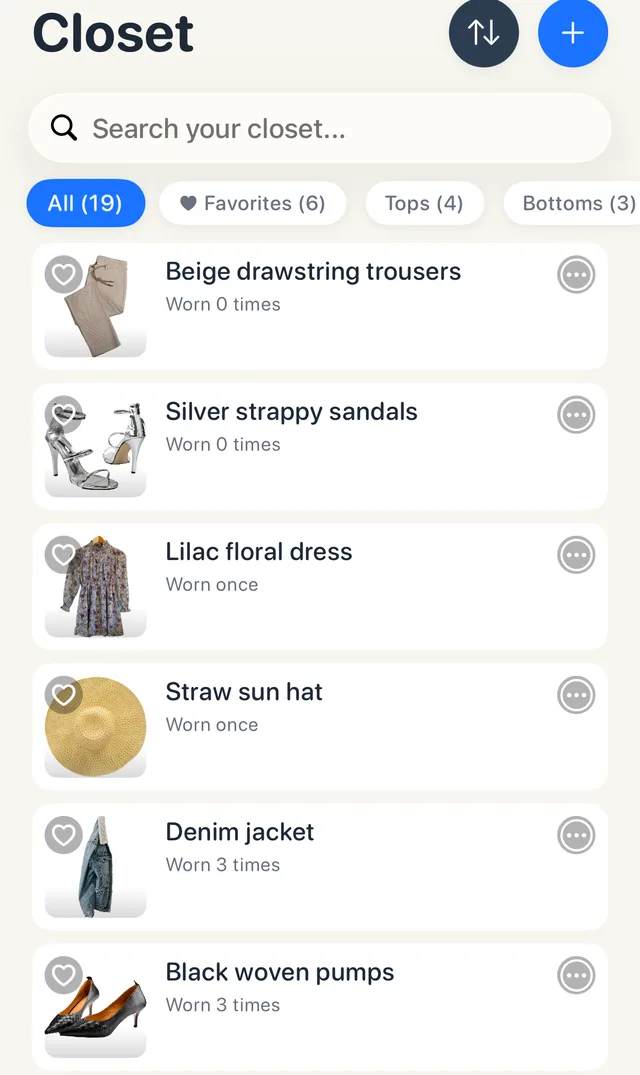
The box already tells you something. To get more, track what you wear every day for 30 days, including the pieces you kept. A note on your phone works ("Tue: dark jeans, green cardigan, ankle boots"), and so does a digital closet.
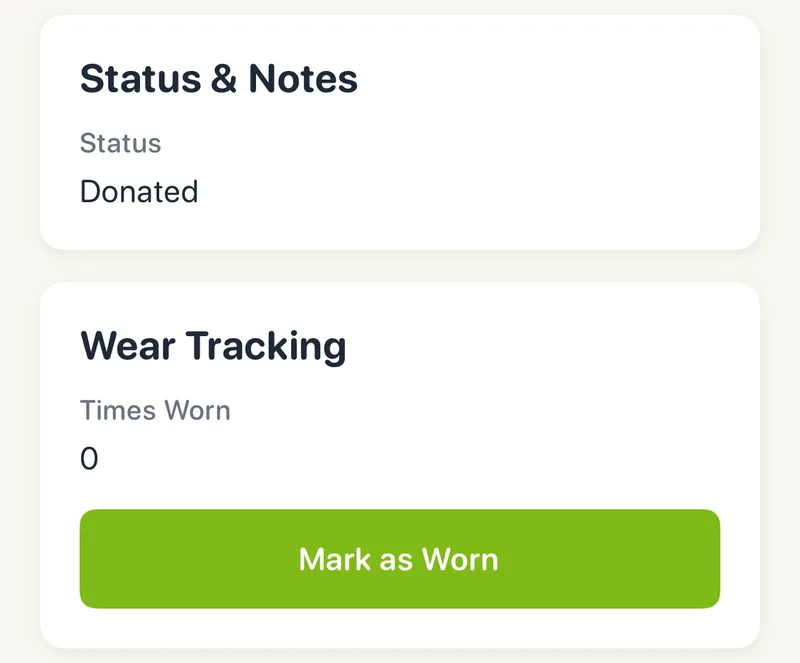
In Looksy, add the pieces you want to test. Each one gets a wear count and a last-worn date. When you wear something, tap Mark as Worn on the item, or on a whole look to count every piece in it at once. Two small tricks help during the month:
- Write "maybe" in the item's notes. The Closet search looks through item notes, so searching "maybe" shows only your maybe box.
- Sort by Least Worn at the end of the month. The pieces you never reached for come to the top, each with its wear count.
The free version holds up to 50 items, so you do not need to photograph your whole closet. The maybe box and your everyday favorites are enough for this test. If you want the full set-up, our guide on how to make a digital closet walks through it in an afternoon.
Step 6: Let the numbers decide
On the decision date, look at what you actually wore.
- Worn two or more times: it earned its place. Back in the closet.
- Worn once: ask why. If you liked wearing it, keep it. If you put it on just to give it a chance and changed before lunch, let it go.
- Never worn: it goes, unless it is out of season or for an occasion that did not come up that month.
Before something leaves, try the shop-your-closet check: can you build three outfits around it with pieces you already wear? Our guide on how to shop your closet shows the method. If three outfits come easily, give it another month. If they do not, you have your answer.
Do the same review for the keep pile now and then. Your most-worn pieces are also your best guide to a smaller closet; our guide on how to build a capsule wardrobe starts from exactly that.
What to do with the clothes that leave
Get the bags out of the house the same week. A bag in the trunk for a month is still clutter.
Donate
Donate clothes that are clean and wearable: no stains, holes or broken zippers. Check your local charity shop's website first; many list what they accept and what they do not. If you are in the US and itemize deductions, the IRS says you can't deduct donated clothing unless it is in good used condition or better, and its value is roughly what similar items sell for in thrift stores, not what you paid.
Sell
Sell pieces in good condition that are still worth something: good coats, boots, bags, and anything barely worn. Take clear photos in daylight, write down the size and measurements, and price it by checking what similar pieces actually sold for. Give yourself a deadline, say two weeks. Anything unsold by then goes in the donate bag.
Repair
Sew on the button, replace the zipper, take up the hem. Small repairs are often quicker than you expect. Pieces you loved until they broke are usually worth fixing.
Recycle
Clothes too worn to donate can often still be recycled. Look for a textile drop-off through your city or county's recycling program, or a take-back program at a clothing store. Don't put clothes in your curbside recycling bin unless your program says it accepts them.
It is worth the extra step. The US Environmental Protection Agency estimates that Americans generated 13 million tons of clothing and footwear waste in 2018, and only 1.7 million tons of it were recycled, a 13 percent recycling rate.
Keeping track in Looksy
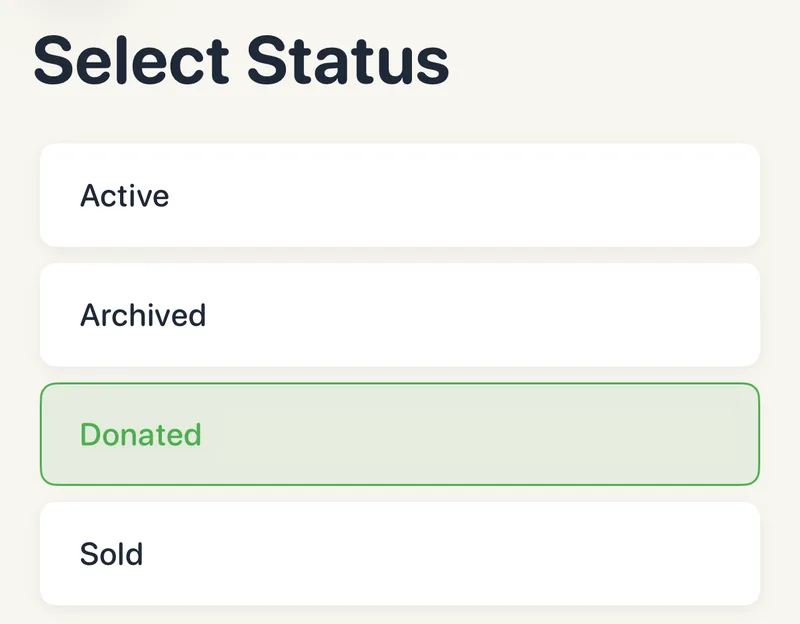
Each item in Looksy has a Status: Active, Archived, Donated or Sold. You set it when you edit an item, in the Status & Notes section, and it shows on the item's detail page. Marking a piece as Donated or Sold keeps its photo, wear count and the price you entered, so you have a record of what left and how much you wore it.
A few things to know before you use it:
- Donated and sold items stay in your closet. They still show in the Closet list, in search and in the sort, and they can still come up in the What to Wear? outfit shuffle. There is no filter that hides them.
- They still count toward the free 50-item limit. If you are close to the limit, deleting an item frees a slot.
- Archived and deleted items cannot come back. Archiving hides an item from your closet and there is no screen to bring it back, and Delete Item removes the item and its photo for good. Only do either when you are sure.
Keep the closet from filling up again
A closet audit works best as a habit, not a one-off.
- Repeat the audit each season. When you swap summer for winter clothes, run the maybe box again.
- One in, one out. When something new comes in, one similar piece goes.
- Keep tracking what you wear. Wear counts show you what you actually like before the closet fills up again.
- Wait before you buy. Before buying something new, check whether you already own a piece that does the same job.
Looksy is free for up to 50 items and 20 looks, enough for your maybe box and the clothes you wear most.

Looksy: digital closet and outfit planner
Snap your clothes into a digital closet, put together looks, plan what to wear on a calendar, and see what you actually wear. Free for up to 50 items.

Common questions
How do I start decluttering my closet?
Start with one section, like tops, and sort every piece into keep, maybe, donate, sell, and repair or recycle. Decide quickly and put anything you are unsure of in the maybe pile. Once one section is done, the rest goes faster.
What is a closet audit?
A closet audit is a piece-by-piece review of everything you own. You take your clothes out, check each one for fit, condition and how often you wear it, and decide whether it stays, goes or needs fixing. Adding a 30-day wear check settles the pieces you are unsure about.
How do I decide what clothes to get rid of?
Ask whether you have worn it in the last year, whether it fits you now, and whether you would buy it again today. For anything you are still unsure about, track what you wear for 30 days. Pieces you never reached for in that time can go, unless they are out of season.
How many clothes should I keep?
There is no right number. Keep what you wear and like, plus clothes for other seasons and special events. If you want a smaller set, a capsule wardrobe built from your most-worn pieces is a good next step.
Does Looksy remove donated or sold items from my closet?
No. Setting an item's status to Donated or Sold keeps it in your closet with its wear count, and it still counts toward the free 50-item limit. Deleting an item removes it for good and frees the slot, but it cannot be undone.